
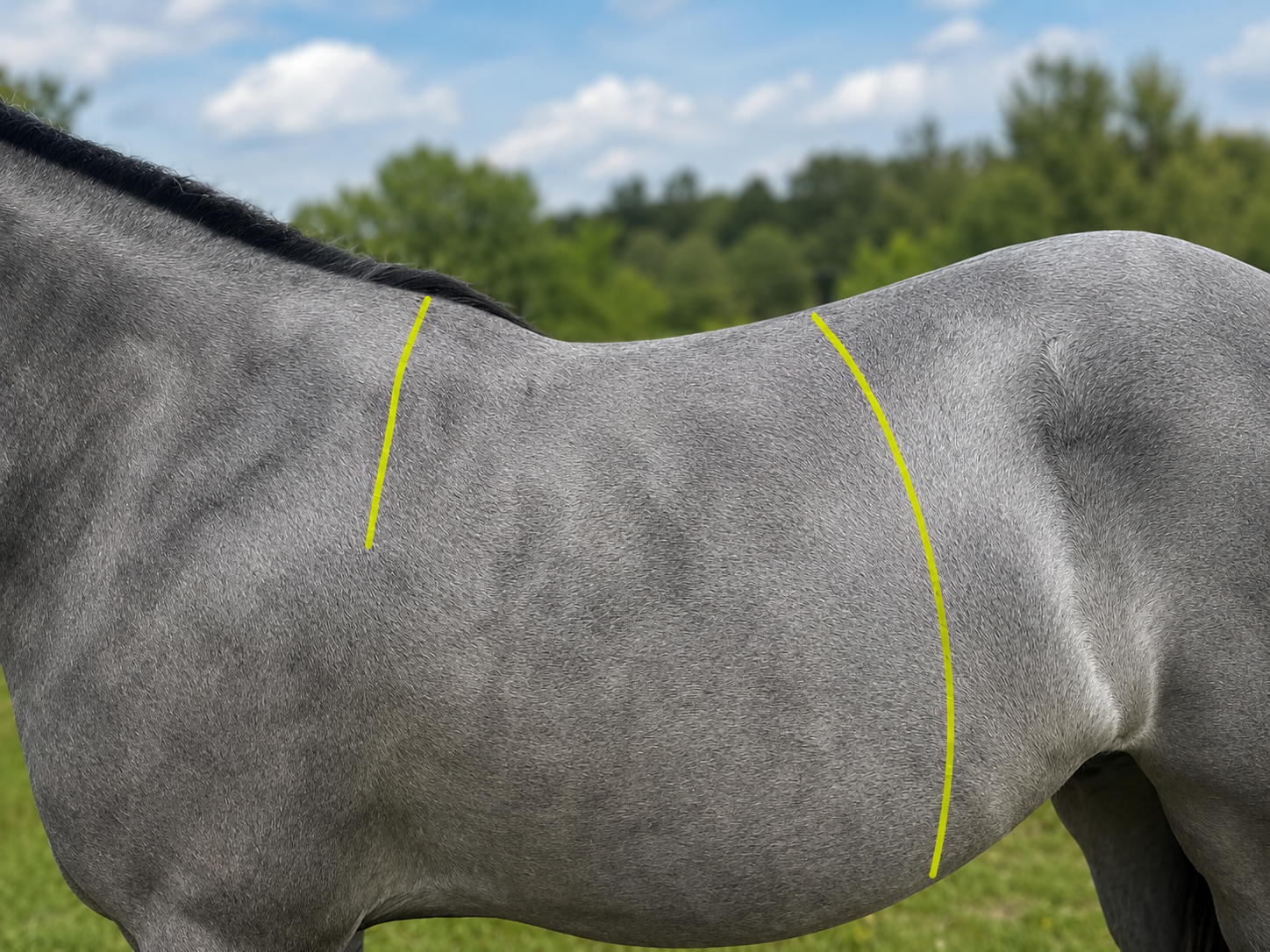
Many riders believe every saddle must end before the last rib. While that guideline can be helpful for some traditional saddle designs, it is not true for all—especially when it comes to Specialized Saddles and TW Saddlery’s patented 3-D Adjustable Fit System. The “last rib measurement” is a common method used to estimate the maximum length of a saddle tree. The idea is that the weight-bearing portion of the saddle should not extend beyond the horse’s last rib.
How Is the Last Rib Measured?
Step 1: Locate the Point of the Shoulder
Find the front of the horse’s shoulder where the scapula (shoulder blade) begins. This is typically where the front of the saddle tree is intended to sit.
Step 2: Find the Last Rib
Starting at the horse’s flank, use your fingertips to feel forward along the rib cage until you locate the last rib. Because the last rib can be difficult to see, especially on horses with more muscle or a thick coat, palpating the rib is often more accurate than relying on sight alone.
Step 3: Mark the Last Rib
Once you’ve located the last rib, follow it upward toward the horse’s topline and place a small piece of tape or make a temporary mark where it meets the back.
Step 4: Measure the Distance
Using a flexible tape measure, measure in a straight line from the point of the shoulder to the mark you made at the last rib. This measurement is commonly used as a reference when selecting an appropriately sized saddle tree.
So Why Is This a Myth?
The horse’s last rib is an important anatomical landmark for saddle fitting. The rib cage provides the primary weight-bearing structure of the horse’s back, while the lumbar (loin) region behind the last rib is not designed to support concentrated pressure.
This is why the guideline of “don’t ride beyond the last rib” has been taught for decades—and for many saddle designs, it is absolutely valid.
However, what often gets overlooked is how different saddle designs distribute weight. The location of the end of the saddle is only part of the equation. The real question is:
Where is the rider’s weight actually being applied?
Why the Rule Applies to English Saddles
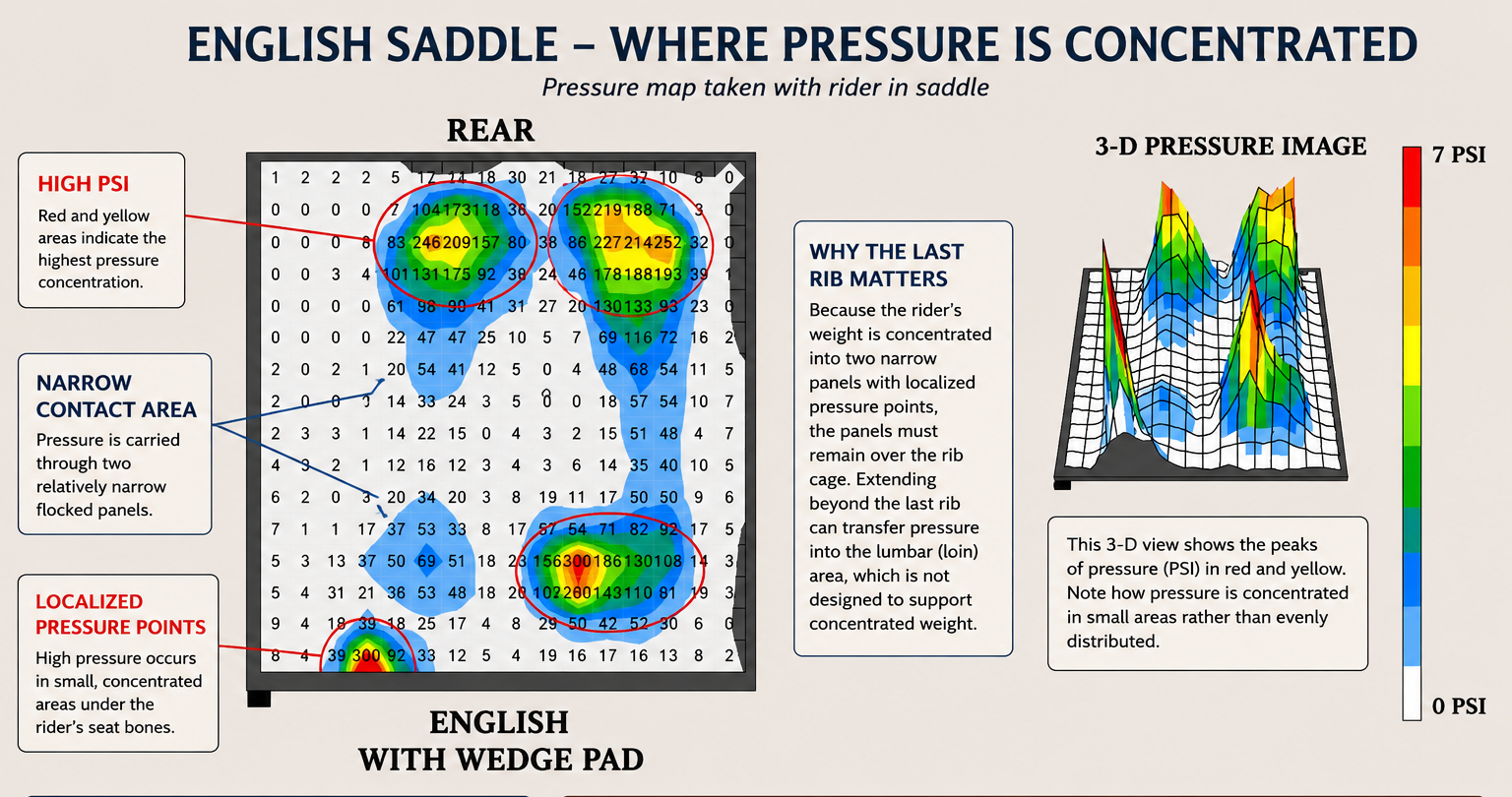
Traditional English saddles rely on two relatively narrow, flocked panels to support both the rider and the saddle. Because the rider’s weight is concentrated into these two long contact surfaces, the panels must remain over the horse’s rib cage where the horse has the structural support to comfortably carry that weight.
If the flocked panels extend beyond the last rib, the pressure can be transferred into the lumbar region where there is little underlying skeletal support. For this reason, the last rib guideline is an essential part of proper English saddle fitting.
The pressure map below illustrates why English saddle panels must remain over the horse’s rib cage. Notice how the rider’s weight is concentrated into relatively small, localized areas beneath the flocked panels.
Western Saddles Are Different
Western saddles distribute weight very differently than English saddles.
Instead of two narrow flocked panels, a western saddle spreads the rider’s weight over broad tree bars that create a much larger contact area. By increasing the surface area supporting the rider, the pounds per square inch (PSI) applied to the horse’s back are significantly reduced.
Not all western saddle trees are designed the same, however.
Why TW Saddlery Is Different
The patented 3-D Adjustable Fit System used in Specialized Saddles and TW Saddlery takes weight distribution a step further.
Our saddle trees are engineered with approximately 3 inches of front flare and 3 inches of rear flare built into the bars.
The front flare allows the horse’s shoulder to rotate and move freely underneath the saddle instead of being restricted by the tree. Because of this design, the saddle can be positioned farther forward while still allowing unrestricted shoulder movement.
At the rear of the tree, the 3-inch flare gradually lifts the bars away from the horse’s back. Rather than carrying weight all the way to the physical end of the tree, the pressure is progressively reduced through the flared section.
For example, although a tree may measure 22 inches in overall length, approximately 16 inches make up the primary weight-bearing surface. The remaining length consists of the front and rear flare, which are designed to reduce concentrated pressure rather than create it.
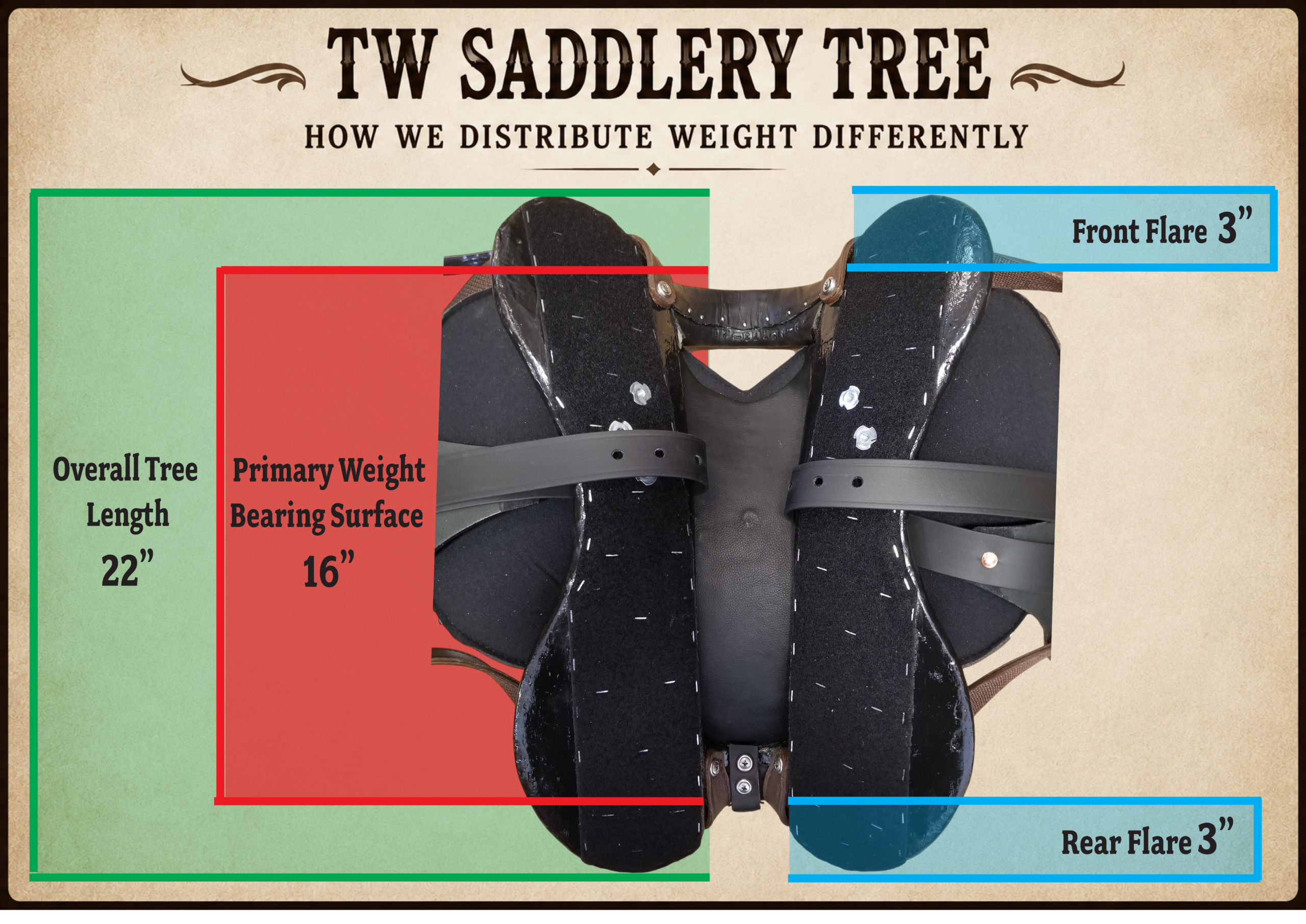
This is why simply measuring the overall tree length from shoulder to last rib does not accurately represent how our saddles distribute weight.
It’s Not About Tree Length—It’s About Pressure Distribution
Many people assume that if the end of a saddle extends past the last rib, the horse is carrying weight behind the rib cage.
With a traditionally designed saddle tree, that assumption may be true.
With a TW Saddlery tree, it is not.
Because the rider’s weight is distributed across a broad surface area and gradually unloaded through the front and rear flare, the pressure applied near the back of the tree is dramatically lower than that of an English saddle or many traditional western saddle trees.
The result is lower PSI, better weight distribution, and a larger effective bearing surface without concentrating pressure into the horse’s loin.
Now compare that to the TW Saddlery pressure map below. The rider’s weight is distributed across a much broader surface area, resulting in lower PSI and fewer concentrated pressure points.
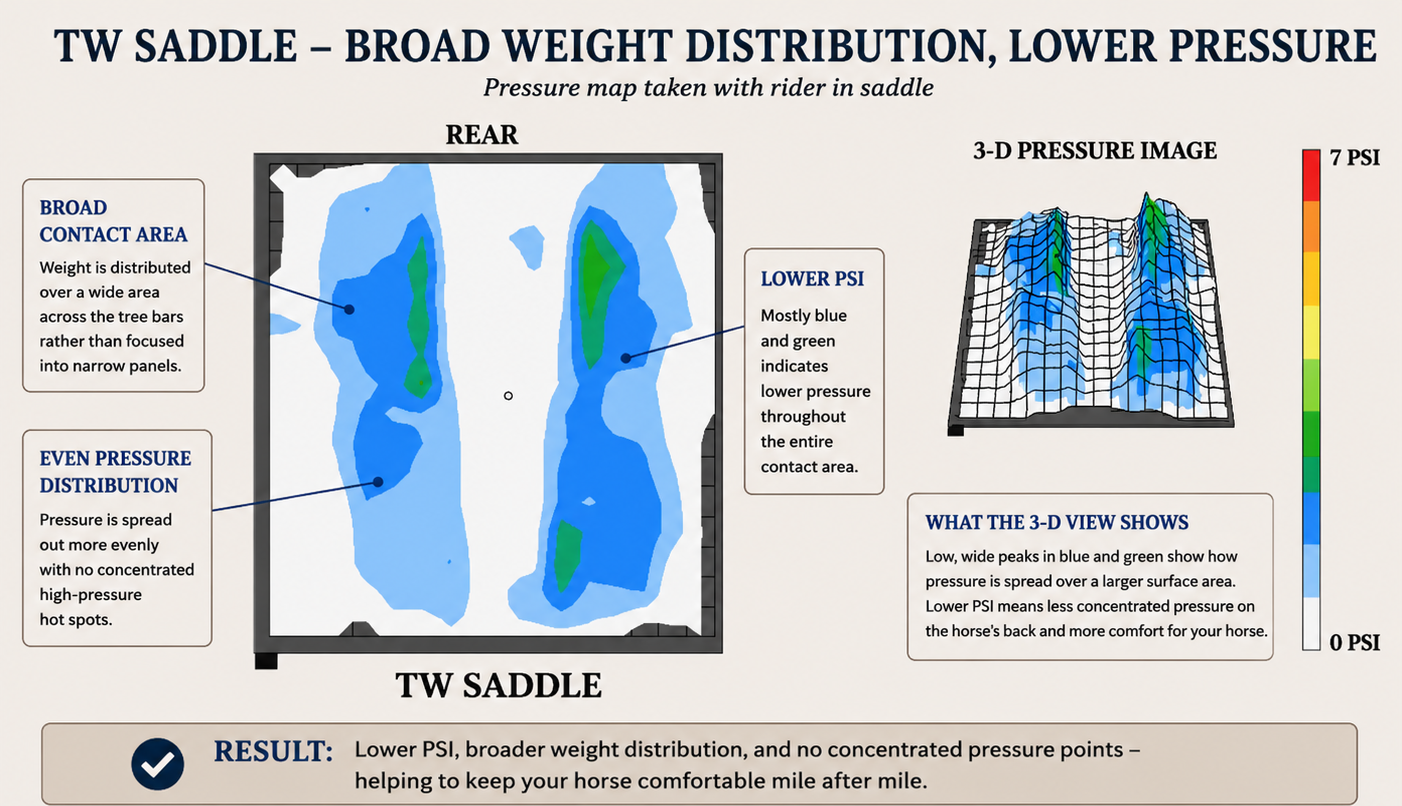
Compare Presure Distribution Between Saddle Designs
Every Horse Is Different
No two horses have the same topline, muscle development, shoulder angle, rib spring, or movement.
Two horses may have identical shoulder-to-last-rib measurements yet require completely different saddle fits because of differences in their conformation and how they carry a rider.
This is why we never fit a saddle using a single measurement alone.
Instead, we evaluate the horse’s entire back, movement, and weight-bearing surface before determining the proper fit.
The Bottom Line
The last rib is an important anatomical landmark—but it is not the sole determining factor in saddle fit.
What matters most is:
- Where the rider’s weight is distributed.
- How much pressure is applied (PSI).
- How the tree interacts with the horse’s back.
- Whether the shoulder and loin remain free from concentrated pressure.
At TW Saddlery, our patented 3-D Adjustable Fit System was engineered to maximize weight distribution while allowing the horse complete freedom of movement. That’s why we evaluate **pressure distribution—not just saddle length—**when fitting every horse.